Category Archives: Carbon

National Highways funding innovative new Kier and TerrAffix trial to cut carbon

An innovative UK-first trial exploring how vegetation removed from highway projects can be reused to make significant carbon savings is being trialled on a National Highways scheme.

Trialled by Kier and TerrAffix on the A417 Missing Link scheme in Gloucestershire, biochar – a charcoal-like material produced by burning organic matter at extremely high temperatures – was produced from vegetation removed by the scheme, turning it back into a product that can be reused to fertilise new plants and catch microplastics.

Biochar

The study produced five tonnes of biochar on site, which is a saving of 13 tonnes of CO2 – the equivalent of roughly five flights from London to Perth.

The next stage of the trial is to use the biochar in different elements of the A417 project, turning waste from the project into a material that is being used to support the project.

  • Landscaping: Biochar will be mixed into the soil when planting thousands of new trees, which will help them establish and grow quicker, while removing more carbon from the atmosphere.
  • Green Bridge: Biochar be used in the construction of the green bridge, which is going to be the largest green bridge in the UK at the time of building. On the deck of a green bridge, manmade gels are normally used to help retain water in dry periods to stop plants dying. Instead, biochar will be used to store and retain the water improve resilience.
  • Microplastics: The biochar will be used to remove microplastics from highway runoff in the highway drainage system.

On completion of the trial, a case study will be developed detailing benefits, improvements and lessons learnt.
This study could then be shared across National Highways and the supply chain to see if it’s implementation can help reduce carbon across future builds.

The study is being co-funded from National Highways’ Environmental and Wellbeing Designated Fund and Kier, the main contractor on the A417 project.

Celine Acard, Senior Project Manager for National Highways, said: “We’re always looking to improve how we design and build our major projects, especially in relation to the environment and our commitment to net zero.

“This trial is incredibly exciting because it means we can look in detail at new ways or repurposing and reusing site materials to cut down on our environmental impact.

“By investing in innovation, we can explore new technology and solutions to protect and enhance the environment and increase biodiversity benefitting communities that live alongside our roads.”

Kier Highways head of environment & sustainability, Matt Tompsett said: “We’ve been working with TerrAffix to prove that using the vegetation cleared as part of the A417 scheme to create biochar for reuse in the construction of the road is feasible.

“In major highways projects we dispose of high levels of vegetation, so to be able to reuse this could be a fantastic example of applying a circular economy model to help reduce carbon and waste, while using a carbon capture and storage technique which means the carbon absorbed by the vegetation will be locked away, instead of releasing it back into the atmosphere.”

Sion Brackenbury, TerrAffix Technical Director, added: “The benefits of an on-site solution are immense. These start with the need to remove vegetation from site, achieving lorry loads of carbon savings, but creating biochar also prevents the slow carbon release to the atmosphere that would ordinarily take place through traditional vegetation processing, such as composting or mulching.

“An additional benefit is the circular economy solution achieved through the reuse of material at a site. This offers soil enhancement opportunities and the promotion of biodiversity.”

Biochar is created through the process of pyrolysis, when organic materials such as trees or vegetation are turned into solid carbon under extremely high temperatures in the presence of little or no oxygen.

Biochar process

This biochar is then reused across the project in new elements such as soil, where it is proven to enhance plant growth, improve nutrient exchange and water retention.

This increases the chance of successful habitat establishment, provides climate change resilience, improves the soils’ ability to sequester CO2 and reduces reliance on synthetic materials such as swell gels.

Using pyrolysis to manage site biomass is a pioneering approach to capturing carbon in construction and reusing it onsite.

The process of pyrolysis will reduce carbon emissions through carbon capture, reduction in vehicle movements and reduction in purchased materials, contributing to National Highways’ carbon reduction targets set out in the Net Zero Plan.

It will also support National Highways objectives to design, build, maintain and operate roads more efficiently and effectively by incorporating a site-won material into the design, reduce waste, reduce carbon emissions and reduce maintenance on the soft estate.

The successful completion of this project will provide National Highways with proof of concept for this approach and could allow for the technology to be deployed across all other suitable highways schemes, supporting National Highways in their objective to deliver better environmental outcomes across all schemes.

Up to 2025, National Highways invested almost £1 billion (£936 million) from its designated funding programme. This money was allocated to four funding streams focused on making improvements that will make the biggest difference and deliver lasting benefits.  

These were safety and congestion, innovation and modernisation, users and communities and environment and well-being.

Kier and TerrAffix embark on new partnership to decarbonise roadside vegetation clearance

In a UK first, the RSK Group company TerrAffix, is embarking on a feasibility study with Kier to look at how vegetation removed from highways projects can be reused on site to make significant cuts to carbon.

Biochar is created through the process of pyrolysis when organic materials are turned into solid carbon under high temperatures in the presence of little or no oxygen.

Biochar in hands

The study will assess if the vegetation removed from large highway schemes can be processed on site using a mobile pyrolysis plant, with the aim of using the resulting biochar in the landscaping programme, which takes place once construction has been completed. The study will outline how best to use the biochar to gain maximum benefit from the overall scheme.

The benefits of this approach include reducing carbon emissions and costs. Often, vegetation on site is removed using large vehicles such as lorries, which increase a project’s carbon emissions. The vegetation is then processed, creating a slow carbon dioxide release to the atmosphere, contributing to climate change.

RSK and Kier embarked on this new partnership after sharing ideas and aspirations at the Highways UK event. Kier then engaged RSK to undertake a study to provide further information on the process and its application.

“The benefits of an on-site solution are immense. These start with the need to remove vegetation from site, achieving lorry loads of carbon savings, but creating biochar also prevents the slow carbon release to the atmosphere that would ordinarily take place through traditional vegetation processing, such as composting or mulching. An additional benefit is the circular economy solution achieved through the reuse of material at a site. This offers soil enhancement opportunities and the promotion of biodiversity.

“TerrAffix believes that for every tonne of woody biomass carbonised, we will produce 250 kg of biochar and 650 kg CO2 equivalent will be sequestered from the atmosphere. On top of this, the heat generated can be used on-site and there will be a more than 90% reduction in traffic journeys that remove vegetation from sites.”

TerrAffix Managing Director Mark Smith

“We’ve commissioned TerrAffix to complete a feasibility study, as we are committed to doing all that we can to complete our work as sustainably as possible.

“In major highways projects we dispose of high levels of vegetation, so to be able to reuse this could be a fantastic example of applying a circular economy model to help reduce carbon and waste, while using a carbon capture and storage technique which means the carbon absorbed by the vegetation will be locked away, instead of releasing it back into the atmosphere.”

Kier Highways Head of Environment & Sustainability Matt Tompsett

Following on from the study, the next steps of the project are to identify a site to trial pyrolysis on. This will allow TerrAffix and Kier to collect further data and understand the added benefits associated with the project.

Kier Highways Head of Environment & Sustainability Matt Tompsett

Revegetating a Challenging Railway Embankment using Hydroseeding

TerrAffix trial vegetated embankment

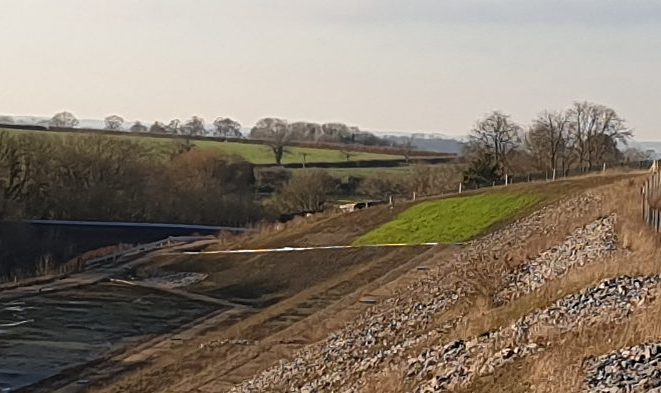
TerrAffix Soil Solutions was invited by Murphy Rail to trial our re-vegetation system on a rail embankment that was proving particularly challenging.

The site was a steep slope of thick, cold clay sub-soil and it was susceptible to heavy run-off over the winter. Previous attempts at establishing vegetation had failed as this sort of soil can be a difficult material for new plants.

These changes can sometimes happen quite quickly, making it difficult for plants to cope.

Clay can shrink and expand in response to heat and water and it can go from being very wet and cold to very dry.

To get plants to grow it is essential to provide the basis for life: moisture, sufficient organic matter to act as a soil-forming material, nutrients and a stable surface during germination.

TerrAffix trial in background where material was added using hydroseeding machinery.
TerrAffix trial in background

Hydroseeding equipment delivers unique mulch

Using our hydroseeding equipment we were able to approach the site in a safe and efficient way.

Following the site survey we decided to use a two-stage revegetation system for the most effective results. We began with an application of TerrAffix-HydraSoil with a microbiological inoculant and a nutrient carrier. This mixture also helps to retain water within the developing root zone during the summer months.

We applied our own fully biodegradable tackifier formula which is composed of a mixture of natural, plant-based materials and sugars. No polyacrylamide was used, which is an everyday tackifier used in hydroseeding.

We then applied a coat of TerrAffix-HydraMulch with seed and natural plant nutrients. This application creates a stable surface on steep slopes, securing the seed in place through germination.

Vegetated soil on the railway embankment post treatment with TerrAffix-HydraSoil and TerrAffix-HydraMulch

We selected seeds from a mixture of fast-establishing species to get some initial cover as well as some deep rooting species. Deep rooted plants tend to be more resilient to drought and act as natural near-surface ground anchors.

The application was made in November which happened to coincide with above-average rainfall. Nevertheless the vegetation established successfully and created a robust, resilient sward.

A key material we use is biochar which is produced at our centre. Biochar not only confers a considerable advantage to plant growth but also sequesters atmospheric carbon dioxide.

Our products come with a carbon lock guarantee which can be accounted for within any corporate social responsibility targets.

United Nations Environment endorses Biochar

TerrAffix HydraSoil close up

TerrAffix HydraSoil close up

A three-year research project into the use of biochar for sustainable soils backed by UN Environment has culminated in excellent results and a thorough endorsement of biochar.

The project trained 500 farmers across six countries to make and use biochar. Johan Robinson, Portfolio Manager for UN Environment Biodiversity and Land Degradation, says:

“The project has demonstrated that nature-friendly solutions have multiple benefits for communities. From improving the productivity of soil to achieve higher yields, to helping manage waste and increasing carbon sequestration capacity – the advantages are clear. It’s now time to think about how to upscale the findings of the project to reach even more farmers globally”.

The multiple benefits of biochar

The exciting results of this project, which included enhanced plant growth (15-20% in one farm’s case) and a significant reduction in the need for fertiliser, highlight the economical and environmental benefits of using biochar made from locally available biomass residues.

TerrAffix Soil Solutions Ltd® is leading the way in the production and use of biochar as a soil remediation solution.

It is already recognised for its value to improve poor or polluted soils and as an element of green roofs. However, its carbon sequestration abilities have been less well understood or recognised up until now.

This UN project adds weight to our belief that biochar can have a fundamental positive impact upon our world.

Greenroof enhanced with Biochar

Greenroof enhanced with Biochar

Biochar in a booming bioeconomy

Polluted landscapes can be recovered, re-establishing soils and vegetation. This means that pollutants are immobilised or soaked up before they reach water courses. Biochar sequesters atmospheric carbon dioxide as it fixed carbon into soil and is used to re-establish the soil ecosystem.

If our technologies, which use biochar as part of the solution, are taken up for use on highly polluted sites and roadside swales around Europe, we could see the start of a really green revolution – a bioeconomic revolution using renewable biological resources.

Biochar’s carbon sequestration abilities will help us to achieve a sustainable global future and reduce the impact of climate change.